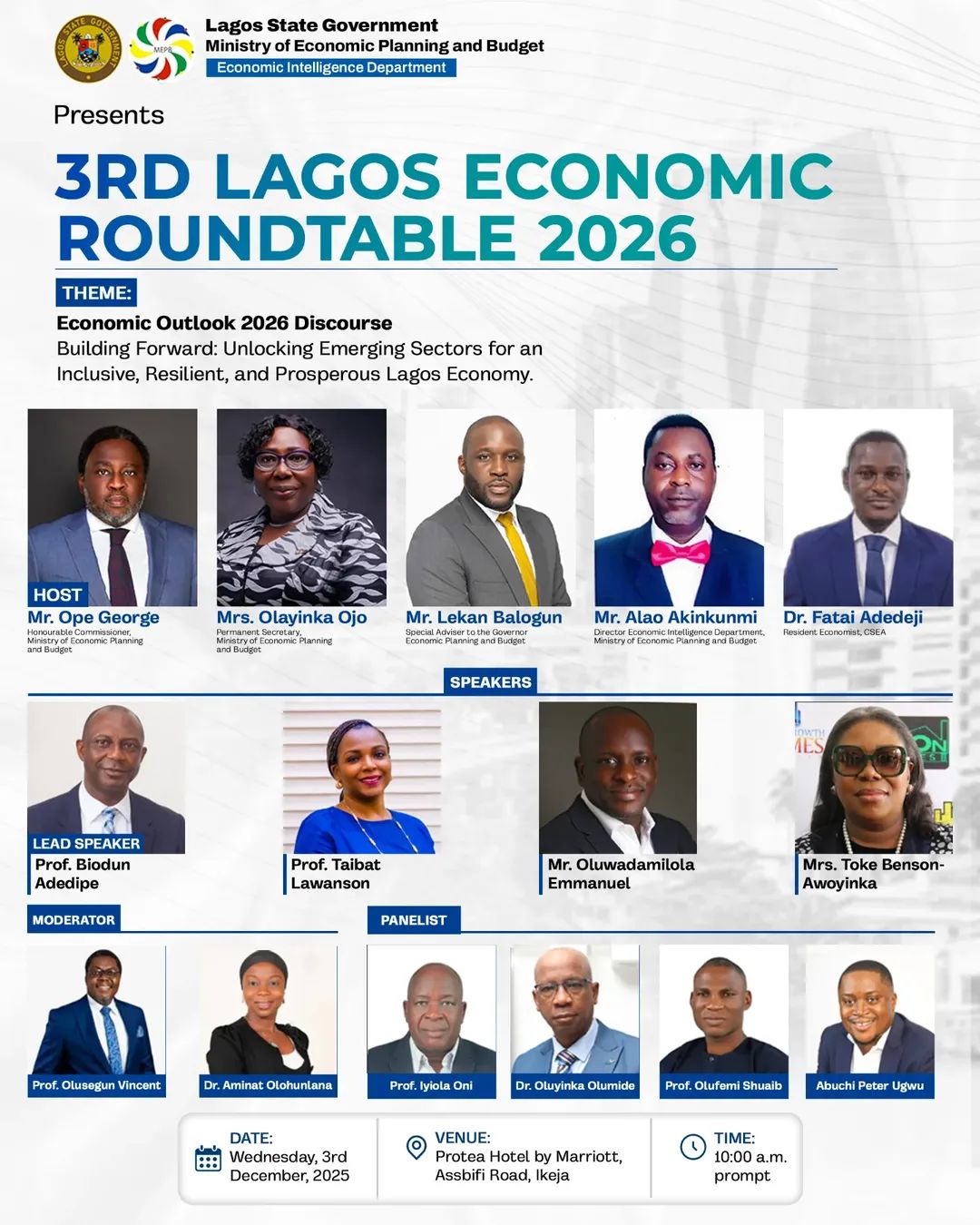
At the 3rd Edition of the Lagos Economic Roundtable 2026, held on Wednesday, 3rd December 2025, the mood inside Protea Hotel, Ikeja, felt less like a conference hall and more like the command centre of a city preparing for its next big leap. Hosted by the Honourable Commissioner for Economic Planning and Budget, Mr. Ope George, the gathering drew Lagos’ finest minds: technocrats, academics, policy strategists, each intent on answering a single question: What must Lagos do now to remain inclusive, resilient, and prosperous?
Inside the hall stood the spine of the Ministry: Mrs. Olayinka Ojo, Permanent Secretary; Mr. Lekan Balogun, Special Adviser to the Governor; Mr. Also Akinkunmi, Director of Economic Intelligence; and Dr. Fatai Adedeji, all anchoring the day’s discourse with quiet authority.
The intellectual charge was led by Prof. Abiodun Adedipe, with incisive contributions from Prof. Taibat Lawanson and Mrs. Toke Awoyinka. Their submissions set the pace for a day that unfolded as a blend of presentations, policy reflections, and spirited debate about the Lagos of tomorrow.
In her presentation on Urban Regeneration and Inclusive Development, Prof. Taibat Lawanson wasted no time confronting the city’s paradox.
“Over 70% of us live in slumlike conditions, in multidimensional poverty,” she warned, arguing that any conversation about the future of Lagos must begin by acknowledging this uncomfortable truth.
Anchoring her submission on four clear questions, she defined urban regeneration as a revitalization process that restores “economic, social, physical and environmental conditions” while redistributing opportunities by creatively aggregating material and intangible resources.
Her emphasis was simple but powerful: Lagos must learn to create new value from obsolete spaces. Forced evictions and indiscriminate demolitions, she said, reflect an outdated model of renewal.
“We need a rethink… one that goes beyond this destruction of assets,” she stressed, advocating community-driven planning anchored on stability, healthcare, culture, education, and infrastructure.
During the Panel Session moderated by Prof. Olusegun Vincent, the panelists stitched together a roadmap for a Lagos that works for all.
Prof. Shuaib doubled down on inequality and food insecurity, proposing a radical shift toward soilless, hydroponic agriculture, already prototyped at the University of Lagos. Small urban farms, he insisted, should become everyday features of Lagos life.
He challenged the 2026 budget to make agriculture an urban strategy, not a rural afterthought.
Dr. Olayinka Olumide lamented the declining interest in agriculture despite heavy investment in agric hubs and scientific processes, urging the private sector to seize unclaimed opportunities.
“There are things the private sector must channel, government cannot do everything,” he argued, pointing to global examples where private enterprise manages even prisons.
Prof. Iyiola Oni pushed commuters toward the waterways, describing the Omi Eko ferries as “safe and affordable,” with an eight-minute Ikorodu-UNILAG commute to prove it. For him, the future of Lagos mobility lies on water, not just asphalt.
In an interview on the sidelines, Prof. Olufemi Shuaib pushed for stronger monitoring and evaluation mechanisms, arguing that Lagos cannot measure progress without understanding impact.
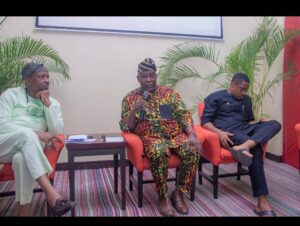
He urged government to “decongest the centre and focus on rural areas,” redirecting development into emerging sub-cities. While commending Lagos’ public-private partnerships, he cautioned that “pricing is always out of reach for the people that actually need it,” urging subsidies in housing and transportation to ensure inclusiveness.
On MSMEs, he observed that streamlining tax policies and widening access to credit will empower more entrepreneurs: “When these are done, more MSMEs will be able to develop and sustain their businesses.”
Across the board, one message dominated: monitoring and evaluation must anchor every development project, ensuring no community is left out of the promise of a new Lagos.
In the end, the Roundtable did more than forecast 2026, it dared Lagos to build forward, not just build more. The vision is clear; the road is steep; but the conversations, rich and urgent, suggest a city ready to evolve with purpose rather than speed.