
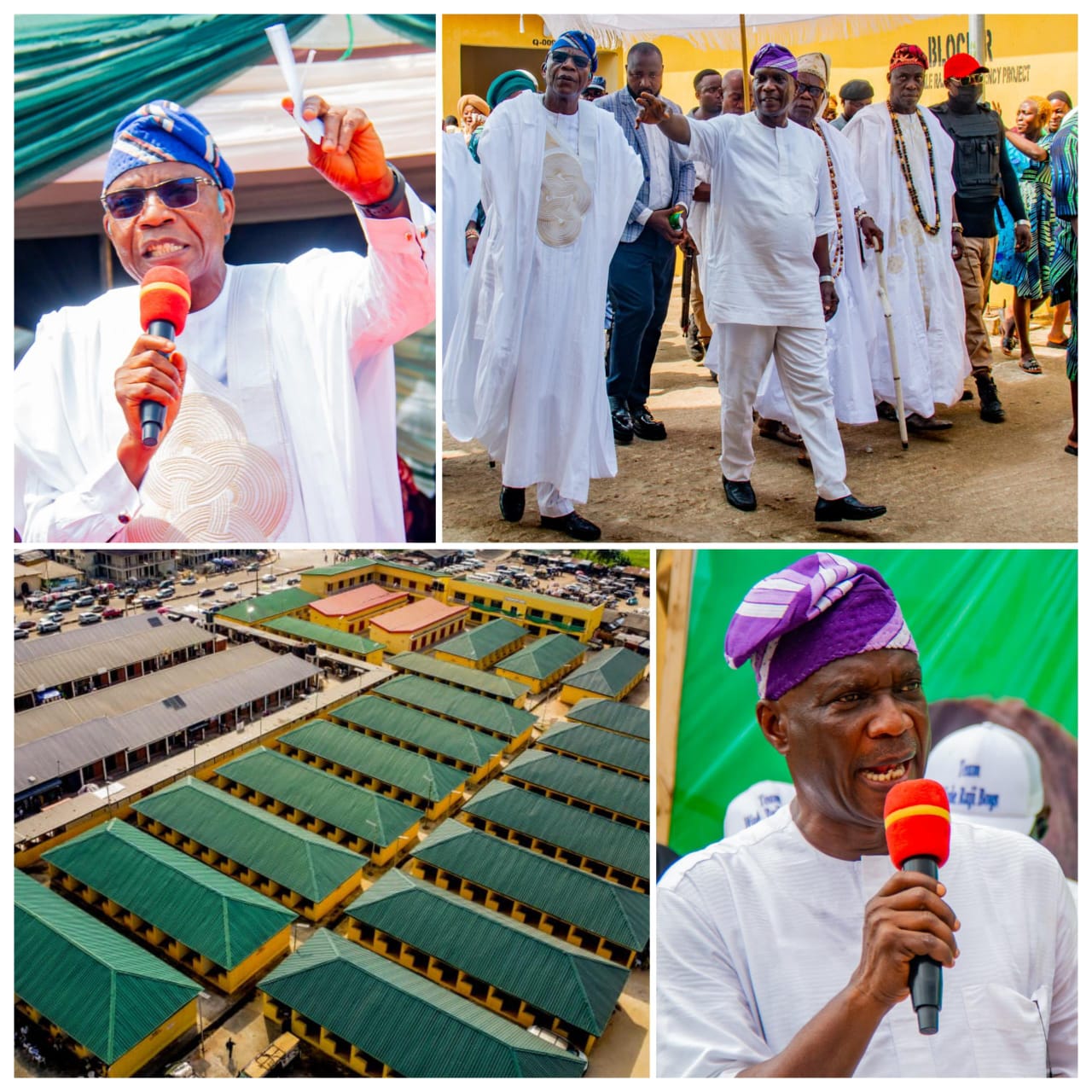
On December 2nd, 2025, Ayetoro did not merely witness another commissioning; it experienced a moment where politics, purpose and providence converged. The allocation of 400 free shops at the Ayetoro Heritage Market, facilitated by Rep. Wale Raji, Member of the House of Representatives for Epe Federal Constituency, stood as a bold declaration that representation, when done right, can permanently alter economic destiny.

Local traders, both old occupants displaced by demolition and new allottees, gathered not as recipients of fleeting largesse but as stakeholders in a carefully thought-out empowerment model. In a commercial hub where annual rent often drains livelihoods, the symbolism was profound: this was relief that would compound yearly.
There was colour and ceremony. The swirl of Aso-ebi, the political class in full presence, the royal majesty of HRM Oba Kamorudeen Ishola Animashaun, Oloja of Epe Land, and the commanding influence of Alhaji Akanni Seriki Bamu, GAC member and Epe Divisional Leader. Saoti Arewa’s sonorous performance added cultural soul to the day. Yet, beyond the fanfare, one voice rose with uncommon authority and resonance.
Pastor Cornelius Ojelabi, former member of the House of Representatives, delivered what many would later describe as more than a goodwill speech. His address unfolded as a political blueprint, a tacit approval, and a subtle forecast of the future alignment between the APC, the people, and Rep. Wale Raji’s style of legislative leadership.

Opening with the party’s progressive creed, Ojelabi declared, “APC progress! May we all be progressive in our lives. May the Lord never forsake us.” But beyond prayer, his message quickly grounded itself in performance and structure which is a rarity in Epe’s political landscape. As he meticulously acknowledged political leaders, traditional rulers and office holders, his protocol served a deeper purpose: to situate development within unity of leadership.
Then came the pivot. Referring to Rep. Wale Raji as “the man of the moment, the man who is never tired of attracting constructional development for the good people of Epe Federal Constituency,” Ojelabi reframed the Ayetoro project as a masterstroke in sustainable empowerment. He went further, addressing the true beneficiaries directly: “The people we are celebrating today, the Iya Oloja and Baba Oloja, may you all be successful in your various business activities.”
What distinguished his speech was its clarity on the philosophy of governance. In words that drew sustained applause, Ojelabi noted that leadership must transcend tokenism: “You should appreciate the Federal Government and forward-thinking APC leaders from Epe Constituency for looking inward, to examine the capacity of whom to send.” In that single sentence, he underscored why Wale Raji’s representation resonates: capacity, not sentiment, drives results.
He contextualised this achievement within a broader continuum of performance, praising Senator Tokunbo Abiru’s senatorial interventions and linking them seamlessly to Raji’s federal footprint. “Epe and by extension, this senatorial district, you are blessed,” Ojelabi declared, adding that effective representation is most potent when excellence flows across tiers of government.
Perhaps the most telling endorsement came when he observed, “This is about the fourth time I am coming to Epe to commission one project or the other.” In Nigerian politics, repetition of delivery is rare currency. Ojelabi’s emphasis was unmistakable: projects had become routine, not exceptional, under Raji’s watch.
Yet, Ojelabi did not ignore the political journey. He thanked the people of Epe Federal Constituency for their unwavering support since 1999, paying particular attention to moments of trial. “What you did to our party during the 2023 election, and the recently concluded local government election, showed your belief in the philosophy of our party and in our manifesto,” he said, referencing the election of Princess Animashaun as proof of renewed confidence.
Stripped of ceremony, the essence of Ojelabi’s message was this: Ayetoro Heritage Market is not a giveaway; it is an economic recalibration, rejuvenation and resuscitation. When the annual cost of rent in such a prime location is computed, the savings returned to traders amount to what can only be described as fortune. This is empowerment that survives inflation, election cycles and applause.
In that light, the commissioning carnival at Ayetoro felt less accidental than inevitable. The APC’s progressive ethos, the people’s sustained electoral faith, and Wale Raji’s brand of legislative activism aligned with near-perfect symmetry. Destiny, indeed, had found a willing instrument.
What remained after the crowd dispersed and the music faded was not noise but evidence: blocks, stalls and opportunity. In an era where politics is often loud and short-lived, Pastor Cornelius Ojelabi’s words captured a deeper truth: when representation is rooted in capacity and vision, fate stops being a gamble and becomes a plan.